Management of Preannotation and Training Servers
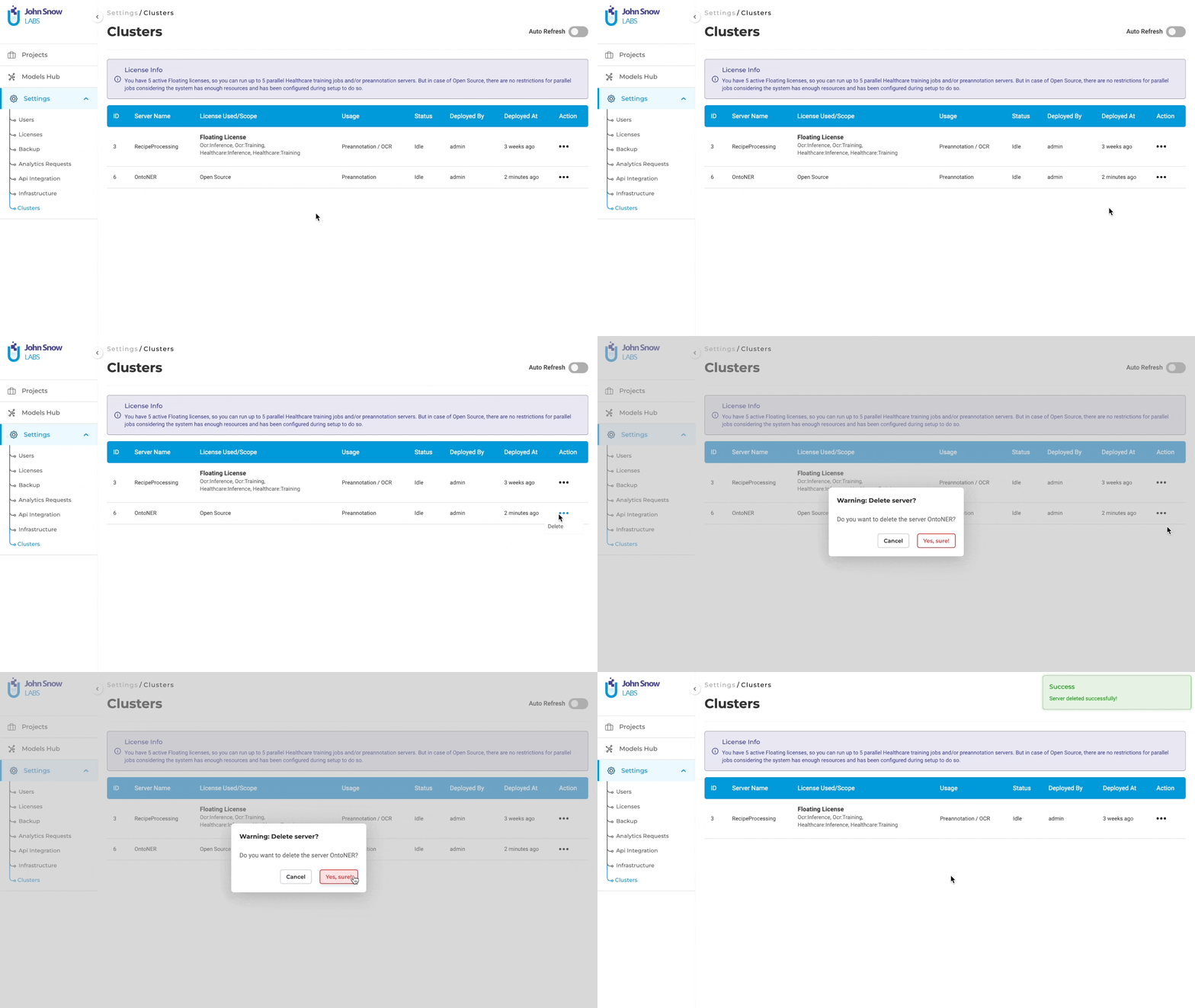
Generative AI Lab gives users the ability to view the list of all active servers. Any user can access the Clusters page by navigating to Settings > Clusters. This page provides the following details.
- A summary of the status/limitations of the current infrastructure to run Spark NLP for Healthcare training jobs and/or pre-annotation servers.
- Ability to delete a server and free up resources when required, so that another training job and/or pre-annotation server can be started.
- Shows details of the server
- Server Name: The name of server that can help identify it while running pre-annotation or importing files.
- License Used/Scope: The license that is being used in the server and its scope.
- Usage: Let the user know the usage of the server. A server can be used for pre-annotation, training, or OCR.
- Status: Status of training and pre-annotation servers.
- Deployed By: The user who deployed the server. This information might be useful for contacting the user who deployed a server before deleting it.
- Deployed At: Shows when the server was deployed.
By default, only 1 server can be initialized for either pre-annotation or training even if there are multiple licenses present. To enable more than 1 servers to be initialized update the below configuration parameter in annotationlab-updater.sh script inside the artifacts folder and then re-run it.
model_server.count=<NUMBER_OF_SERVER_TO_INITIALIZE>
airflow.model_server.count=<NUMBER_OF_SERVER_TO_INITIALIZE>
To run the script:
sudo ./annotationlab-updater.sh
Status of Training and Preannotation Server
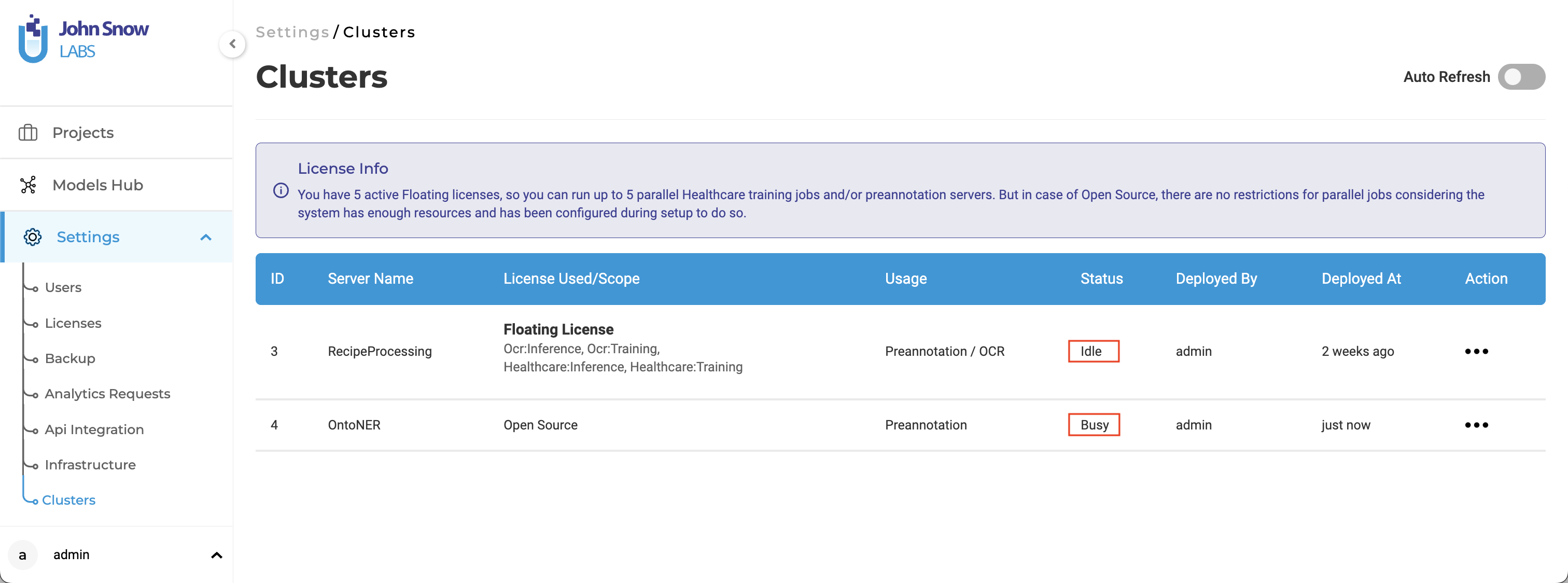
A new column, status, is added to the Clusters page that gives the status of training and pre-annotation servers. The available pre-annotation server statuses are:
- Idle
- Busy
- Stopped
Users can visualize which servers are busy and which are idle. It is very useful information when the user intends to deploy a new server in replacement of an idle one. In this situation, the user can delete an idle server and deploy another pre-annotation/ training server. This information is also available on the pre-annotation popup when the user selects the deployed server to use for pre-annotation.
Also, if any issues are encountered during server initialization, those are displayed on the tooltip accessible via mouse-over. Depending on the issue, changes might be required in the infrastructure settings, and the user will have to manually redeploy the training/pre-annotation server.

Enhanced Cluster Management Dashboard
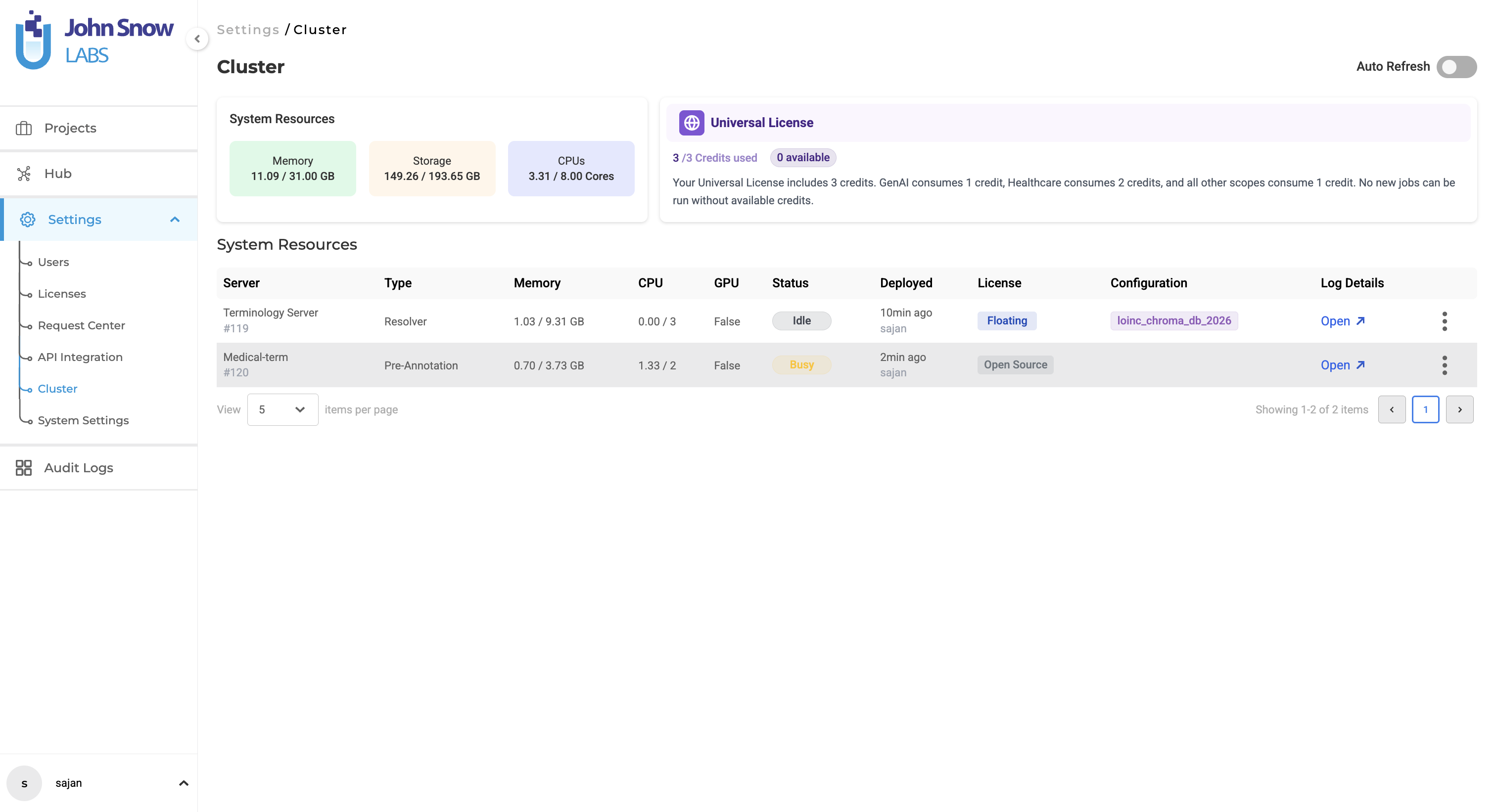
Version 8.0 introduces an enhanced Cluster Management Dashboard with improved visibility into system resources and deployed configurations.
System Resource Summary
A new resource summary section appears at the top of the Cluster page, displaying real-time usage for:
- Memory: Consumed vs. total capacity
- CPU: Core usage across active deployments
- Storage: Storage consumption and availability
Resource metrics are calculated dynamically across all active servers, enabling at-a-glance capacity monitoring.
Configuration Visibility
Server configurations are now displayed directly in the Cluster table using inline tags:
- Pre-annotation servers: Show deployed models, rules, and prompts
- Medical Terminology servers: Show deployed terminologies (ICD-10, LOINC, CPT, etc.)
This provides immediate visibility into which assets are deployed on each server without requiring additional navigation.
Enhanced License Information
The license banner provides contextual information based on license type:
- Airgap License: No deployment limit (constrained by system resources only)
- Floating License: Shows concurrent job slots with real-time usage
- Universal License: Displays credit-based usage with consumed and available credits
Note: License metrics reflect only servers deployed within the current instance. Usage from other instances is not included.
Resource Allocation Details
Each server entry now includes explicit resource allocation:
- Assigned memory
- Allocated CPU cores
- Storage capacity
Combined with the resource summary, this enables administrators to understand how resources are distributed and plan capacity effectively.